Showing posts with label critters. Show all posts

Tuesday, February 14, 2012

Summer of ground squirrels

By all accounts, the summer of 2010 was a good one (though I waited until January 2012 to finish writing about it). My favorite count, though, is the number of species of ground squirrels I saw this summer: at least seven. I had the good fortune to travel to a number of places with new and different non-arboreal scurids this summer.

Why bother studying ground squirrels? The best reason is that they're adorable. The second-best reason is that their numbers and habits make them among the most readily observed mammals in North America. I could spend my whole vacation in a blind waiting for a monkey-faced disco hawk or some other rare bird or mammal to come into view for a few seconds, or I could take a short walk along a talus pile on a sunny day and see who pops up. I took all the pictures below with my Canon Powershot SX110 IS, a nice but not terribly expensive point-and-shoot with a 10x optical zoom.


1. California ground squirrel, Otospermophilus beecheyi
Lisa and I saw this little fella, formerly known as Spermophilus b., on a bay-front walking path in Alameda, California.


2. Golden-mantled ground squirrel, Callospermophilus lateralis
This handsome rodent, formerly called Spermophilus l., superficially resembles a chipmunk, but is distinct in that chipmunks' stripes extend onto the face. This guy was scampering among the rocks at a Donner Pass Road overlook in Nevada County, California, near the famous Donner Summit Bridge. The American Society of Mammologists species account describes its running gait as "clumsy" (ASM Report #440, Spermophilus lateralis, 1993), which seems unnecessarily harsh. Perhaps the authors had observed only pubescent ground squirrels going through that awkward phase - want to make fun of their cracking voices and acne, too? Not cool, mammologists.

We also saw a yellow-bellied marmot there; my mother-in-law almost ran it over (unintentionally), but he safely scampered away.


3. Belding's ground squirrel, Urocitellus beldingi
Despite appearances, this guy is not a prairie dog. Formerly known as Spermophilus b. (noticing a pattern here?), this squirrel hangs out in alpine meadows. His habit of standing bolt upright to watch for danger led early settlers to call him the "picket pin". There was a small colony of these guys in the summit resort area at Squaw Peak.

4. Yellow-bellied marmot, Marmota flaviventris
Mr. Chubby-Cheeks here was seen hiding in a landscaped rockpile next to the hot tub at the Squaw Valley summit resort area. Lisa pointed out that some of the teenagers in and around the hot tub probably thought I was being creepy, hanging around with a camera in hand. I don't care - this picture was worth it. Click to enlarge it - you can see the marmot's nose hairs!

5. Chipmunk, Tamias sp.
This handsome rodent was spotted on a talus pile at a Lake Tahoe overlook and could be one of three species:
Tamias amoenus - Yellow-pine Chipmunk
Tamias speciosus - Lodgepole chipmunk
Tamias quadrimaculatus - Long-eared Chipmunk


6. Thirteen-lined ground squirrel, Ictidomys tridecemlineatus
This many-striped ground squirrel was known as Spermophilus t. prior to taxonomic revision. Lisa and I saw this individual feeding on some spilled popcorn on the central mall at Brookfield Zoo, in the Chicago suburbs. Nothing like a good stretch while eating unpopped kernels of salty goodness, eh?


7. Woodchuck, Marmota monax
I saw this chunky 'chuck at a family friend's place in Waukesha County, Wisconsin, on Labor Day. I think he safely sneaks under the radar as the last official ground squirrel of the summer. In some parts of the country, it's socially acceptable to call this animal a "whistle-pig", which is awesome.


View Summer of Ground Squirrels in a larger map


My identifications were assisted by:
  • Squirrels of the West. by Tamara Hartson (Lone Pine Publishing, 1999). I stumbled across this book in a Forest Service visitor center and instantly knew I had struck gold. I also recently acquired Squirrels of North America by Tamara Eder, who apparently is the same person.
  • San Francisco State University - Sierra Nevada Field Campus species list
  • National Audubon Society Pocket Guide - Familiar Mammals of North America
  • American Society of Mammologists species accounts (#221, #440, and others); some of them are freely available

Saturday, November 20, 2010

Sleepy badger


Look at him, he's probably dreaming about mauling prairie dogs.

Sleep well, my ill-tempered friend.

Seen a while ago at the NEW Zoo, near Green Bay, Wisconsin.

Sunday, November 14, 2010

Bears and minivans: a love story

Bears love minivans. I stumbled across a recent (2009) paper in the Journal of Mammalogy which demonstrates this scientific fact:
ABSTRACT: Black bears (Ursus americanus) forage selectively in natural environments. To determine if bears also forage selectively for anthropogenic resources we analyzed data on vehicles broken into by bears from Yosemite National Park, California. We classified vehicles into 9 categories based on their make and model and collected data on use (2001–2007) and availability (2004–2005). From 2001 to 2007 bears broke into 908 vehicles at the following rates: minivan (26.0%), sport–utility vehicle (22.5%), small car (17.1%), sedan (13.7%), truck (11.9%), van (4.2%), sports car (1.7%), coupe (1.7%), and station wagon (1.4%). Only use of minivans (29%) during 2004–2005 was significantly higher than expected (7%). We discuss several competing hypotheses about why bears selected minivans.
Basically, the authors looked at the National Park Service database of bear vehicle break-ins in Yosemite Valley from 2001 to 2007 and broke down the data by the bruins' choice of vehicle type for each nocturnal breaking-and-entering session. Even though minivans represented only 7% of the vehicles parked overnight in Yosemite Valley, an astounding 28% of all ursine vehicular incursions were directed against minivans.

Read the article for yourself (not sure how long this link will persist.)

Why do bears love minivans so much? Is it the comfortable bucket seats, the generous cargo area, the convenient sliding doors, the "not great but really pretty ok for a big car" gas mileage? It is well known that bears enjoy all things automotive: outside Denver, a bear broke into a car, put it in gear, and crashed it into a tree. The car was a total loss. Back to minivans, though, it turns out that the convenient sliding doors and adjustable seats are part of the allure. One of the authors was quoted in a San Francisco Chronicle article on the study as saying that bears pry open the doors, tear out back seats, and pop open windows (rear side windows are apparently their favorite entry route) in their quest for people food stashed in minivans. Do the bruins favor vehicles with Stow-N-Go seating for easy removal of back seats? The results are unclear, but my thought experiments strongly indicates the answer may be yes.

In the end, the answer comes down to children. Not that the children are themselves food for the bears (really, only witches regularly consume children, though the occasional ghoul will take a child in opportunistic feeding situations), but insofar as minivans are likely to be used to transport children, who grind Goldfish dust soaked with Capri Sun into the upholstery. No matter how fastidious the grown-ups are about not leaving food in the van, the atomized food particles in the seats are sufficiently odorous to compel a passing bear to break and enter in hopes of scoring a pawful of Cheerios and a Sunny D chaser.

Sounds like folks across the Pacific are no better off. According to several reports, bear attacks are on the rise in Japan. Are Japanese bears smaller and more efficient maulers? That's unclear, but the Land of the Rising Sun has a storied history of bear attacks. The man-eater was probably just frustrated because minivans wouldn't be invented for another 70 years or so.

Reference:

Stewart W. Breck, Nathan Lance, and Victoria Seher. (2009). "Selective foraging for anthropogenic resources by black bears: Minivans in Yosemite National Park". Journal of Mammalogy 90(5):1041–1044.

Sunday, September 12, 2010

Badger vs. Wolverine

Forget "Pirates versus Ninjas." Let's talk about a long-anticipated duel of Pleistocene relicts1. A civil war in the family Mustelidae. A clash of famously bad-tempered North Americans who lead bizarre triple lives as angry carnivores, official state mammals, and Big Ten mascots. Let's talk about badgers and wolverines.


My interest in badgers, particularly the American badger (Taxidea taxus), is well known to anyone who can stand to be in the same room as I am for more than fifteen minutes. On more than one occasion, I have identified myself to zookeepers as a "badger enthusiast." While Eurasian badgers (Meles meles) tend to be social, American badgers are infamously cranky. They can barely stand each other long enough to mate.

The wolverine (Gulo gulo) is one of those interesting critters that enjoys a circumpolar distribution - that is, they are found at similar latitudes throughout Eurasia and North America. While they superficially resemble bears, they are actually overgrown weasels. Wolverines are legendarily badass. Its scientific name means "glutton." They have been observed chasing grizzly bears away from a kill.

The badger and the wolverine are the represented in the state nickname, official state mammal, and university mascots of Wisconsin and Michigan, respectively. In both cases, the reason for the affinity has little to do with the animal itself. The name "badger" for a resident of Wisconsin comes from the early days of lead mining in the southern part of the state, when miners would spend the winter living inside their tunnels2. The miners' fossorial habits led to their being known as "badgers." Michigan became known as the Wolverine State during the Toledo War3, a boundary dispute between Michigan and Ohio over the Maumee Valley. The Ohioans reacted to the Michiganders' attempt to usurp territory by proclaiming that "Michigan is as hungry for land as a wolverine is for flesh." While there are wild badgers in Wisconsin, there are very few records of wolverines in Michigan in historical times4, and these are believed to have wandered in from Canada or been released as exotic pets which have outgrown their welcomes.

Returning to the question at hand, the Smithsonian Institution's National Museum of Natural History may have the answer: in the battle of badger versus wolverine, the winner is...the musk ox?


With that issue settled, I can finally sleep at night. Animal mounts above seen at the NMNH Hall of Mammals.


1 Relict refers to a "remnant of a formerly widespread species that persists in an isolated area (M-W)." For example, pika populations at low elevations in the Great Basin are relicts of a period of cooler climates.

2 Miners in the lead districts of northern Illinois, by contrast, traveled up the rivers to the mines in the spring and back down the rivers in the fall, mirroring the migration of suckerfish. Illinois is sometimes known as "The Sucker State" as a result, though most Cheeseheads are content to call us "Illinoyances."

3 In the end, Ohio held on to Toledo and the Maumee Valley, and for some reason, Michigan got the Upper Peninsula as a consolation prize. No wonder the Yoopers feel ignored by the government in Lansing and occasionally talk of secession.

4 A wolverine was sighted in the "Thumb" of Lower Michigan in February 2004. It was tracked by a devoted high school science teacher for several years until it died of natural causes in March 2010. It is believed to have been a released exotic pet.

Thursday, September 2, 2010

Marmots with hard hats!


I saw this at an exhibitor's booth at the International Society of Explosives Engineers conference last winter and it pretty much blew my mind. I shouldn't have been too surprised, though - it is well established by the work of many eminent rodent biologists that the yellow-bellied marmot (Marmota flaviventris) is very safety-conscious. Hard hats and steel-toe work boots are the rule around the burrow. These marmots score points with Lisa for practicing good aural hygiene, too, as they're wearing earplugs with at least a 29 dB noise-reduction rating. Shouldn't they be wearing eye protection, though? And what about dust masks? Oh well, Rodent OSHA will let them off the hook, I'm sure, on account of their fuzzy-wuzzy marmot tummies. Just don't do it again, guys. Seriously.

In case you were wondering, the marmots are hawking products to improve performance of "stemming," the inert material (crushed rock 'n' stuff) used to backfill blasting boreholes after the explosives have been installed at the bottom of the hole. The stemming prevents the pressure from the explosion from simply being vented out the borehole.

Tuesday, June 15, 2010

Nice marmot.

And also, let's not forget - let's not forget, Dude - that keeping wildlife, um, an amphibious rodent, for, um, you know, domestic...within the city - that ain't legal either.

Marmota flaviventris seen at Donner Pass, Nevada County, California.

Sunday, February 21, 2010

Do not poke the rattlesnake

In June 2005, I had a run-in with a snake at one of my favorite places: the dells of the Wolf River in Menominee County, Wisconsin. Slithering about on the billion-year-old Wolf River basalts was this fellow:

The snake then coiled up and began to shake its tail in the underbrush, making a rattling sound. This got my attention, and I took several steps back to establish and more respectful distance. For the next five years or so, I bragged to my friends that I had stared down a rattlesnake.

In a recent visit to the Henry Vilas Zoo in Madison, Wisconsin, I learned that there are two species of rattlesnake in Wisconsin, and neither occurs anywhere near Menominee County, highlighted in blue on the maps below (range maps photographed at the Vilas Zoo).

This was confusing - I heard the snake rattle! I was traveling Lisa and her parents, so I had to come up with an explanation quickly. The answer came from the kids' section of the Wisconsin Dept. of Natural Resources web site - that's right, the kids' section. Turns out there are at least two non-venomous Wisconsin snakes that twitch their tails in the leaf litter to imitate a rattlesnake: the fox snake (Elaphe vulpina, also known as the pine snake) and the rare bull snake (Pituophis melanoleucus). Humbled!

When I got home, I checked the WDNR's excellent pamphlet, Snakes of Wisconsin, and determined that the handsome reptile in question was in fact a fox snake. The orange head is the giveaway. I'm no biologist, but I think being slightly out of focus is also a characteristic of the species.


While I hadn't faced a hyper-venomous death-serpent, I still consider myself lucky to have experienced this encounter with the herpetofauna of the Badger State. Meanwhile, I'm pleased to announce that I recently did stare down a timber rattlesnake (Crotalus horridus)...


...but this one was behind glass at the Vilas Zoo's reptile house. I'll close with some helpful advice from the good folks at the zoo:

Friday, July 3, 2009

Things I did before noon today

1) Got pooped on by a garter snake (Thamnophis sp.)

Don't give me that look, snake. You know what you did.

Sunday, June 28, 2009

Jobs I want: bison tranquilizer-er

Here's another job inspired by television. I'm watching a show on Animal Planet about the bison of Yellowstone National Park. The program follows a crack team of National Park Service biology commandos as they study bison migration in and around the park. I couldn't find a photo of an NPS warrior-biologist in action, so I stole the image at left from Parks Canada1. Part of the study involves attaching tracking collars on the animals. This requires the following five-part plan:
  1. Locate bison.
  2. Shoot bison in ass with tranquilizer dart.
  3. Take blood samples and attach collar, all while watching for curious four-legged passers-by.
  4. Inject bison with wake-up juice.
  5. Run.
I'm pretty sure that the person who pulls the tranquilizer dart gun trigger is called a tranquilizer-er. As best I can tell, the appeal of being a bison tranquilizer-er is fivefold:
  • Self-reliance. Ain't nobody going to help you in the case of mechanical failure or repeated gorings. It's just you and your hand-picked team of stone-cold, hard-core, devil-may-care wildlife biologists against 1500 pounds of groggy bovine.

  • Development of dart gun sniper skills. Now that I think about it, the combination of cross-country skiing and precision shooting might appeal to Lisa's Finnish heritage.
    Note to self: book non-refundable winter travel tickets and investigate dart gun license requirements.

  • Having The Handbook of Wildlife Chemical Immobilization on your bookshelf and not having to explain it. I love obscure how-to literature.

  • SCIENCE! Come on, what is biology if not poking and prodding large wild animals? Put your microscopes away, kids; we're going to learn something even if it kills us by goring and trampling.

  • Clarity of purpose: shoot bison in ass, do science, run away. That's the best reason to get out of bed this side of averting alligator attacks.


1 Stolen from this article on a Parks Canada wildlife veterinarian. Read it in French if you prefer.

Sunday, May 17, 2009

Mini-possum

Lisa and I saw this yesterday while walking down a residential street in Evanston.

It's a baby opossum, Didelphis virginiana! This minuscule marsupial was just a few inches long - note the blades of grass for scale. We heard some rustling and a strange whistling or squeaking sound under a bush near the sidewalk, and there it was. Perhaps surprisingly, 'possums are pretty cute when they're little.

When I was about ten, a 'possum briefly took up residence in our garage. It relaxed on the workbench, apparently confident that its scrofulous visage and toothy jaws glistening with methatherian drool would keep most anyone at bay. The beast eventually left the premises on its own.

Amazingly, there are at least two non-profit organizations dedicated specifically to 'possums: The National Opossum Society and The Opossum Society of the United States. The web site of the latter features an animated GIF of a 'possum wagging its tail; they also sell 'possum earrings. Too bad I learned about this right after Lisa's birthday.

Friday, April 17, 2009

Arboreal skunks and other surprises

Three things blew my mind while watching "Is that Skunk?" on the PBS program Nature.
  1. Spotted skunks (Spilogale spp.) commonly climb trees to forage and hide.
  2. Skunks are not members of family Mustelidae, the weasels, as was long thought. Apparently skunks compose their own family, Mephitidae.
  3. Skunk spray is highly flammable. Significantly, this was reported by an organic chemist rather than a field researcher.
Bonus: "For these orphaned skunks, Jerry is acting in loco parentis. However, many would call him just plain loco." Oh, Omniscient PBS Narrator, you're so clever.

Friday, March 6, 2009

Muskrat Love

My skills as a critter enthusiast ("amateur naturalist" sounds way too pretentious) have finally proven useful to humanity. At work yesterday, one of my colleagues got a report from his wife that there was an unusual critter swimming in the creek next to their home. She thought it might be an otter. I decided that a river otter (Lutra canadensis) in a shallow Chicagoland creek would be highly unusual, though not inconceivable1, so I asked if she could send me a picture2. This is what she sent:


It's a muskrat! Oh, excitement!

The muskrat (Ondatra zibethicus) is one of my favorite local critters. Curiously, muskrats are not closely related to beavers, in spite of the superficial resemblance and similar habits. While they are both rodents, muskrats are most closely allied with voles and lemmings, while beavers' closest relatives are the pocket gophers and kangaroo rats.

I learned only yesterday of the song "Muskrat Love," made popular by The Captain and Tennille in 1976. It seems elicit strong reactions in people - it was a Top 40 hit, but was also placed high on CNN's list of the worst songs in popular music. Apparently you either you love it or it. At this point, frankly, I'm just confused by it.

The utility of muskrats, however, transcends even the music of the mid-seventies. According to the Roman Catholic Archdiocese of Detroit, muskrat is considered "fish" rather than "meat" for the purpose of observing meatless Fridays during Lent. Legend holds that this custom dates back to a priest ministering to trappers in southeast Michigan during the early 1800s who found that trappers' families were going hungry without meat during Lent. The priest reasoned that the aquatic muskrat could be considered "fish" and not "meat," allowing the faithful to obtain needed protein without breaking their Lenten vows. A 1987 opinion by the bishop of Lansing held that this "immemorial custom" was acceptable under canon law; perhaps more importantly, the bishop was unimpressed with the gastronomic value of muskrat, declaring that "anyone who could eat muskrat was doing penance worthy of the greatest of the saints."


1In December 2007, commuters leaving Union Station in downtown Chicago saw otters along the South Branch of the Chicago River.

2Sending a picture of a critter for me to identify constitutes implied oral consent for me to redistribute the picture. This means you, Major League Baseball!

Sunday, December 28, 2008

Nuisance animals

Two days ago, we visited the Minnesota Zoo. I was snapping pictures of the wild boar (Sus scrofa) in the excellent "Russia's Grizzly Coast" exhibit, when I overheard a fellow visitor saying, "It's just like someone in Poland watching Canada geese." This was followed by some chatter between other members of that group in what sure sounded like Polish - and I've lived in metro Chicago long enough to know a Slavic language when I hear one. I couldn't help but chuckle to myself when I heard this, because she was absolutely right. In both the Twin Cities and Chicago regions, Canada geese (Branta canadensis) are a nuisance. They may even qualify as vermin in some areas.

In high school gym class, we played touch football - which, as you might expect, was touch football in name only - on the practice football field, out at the furthest corner of school grounds. Whenever it was not occupied by bellowing adolescents, the field was preferred grazing area for an apparently non-migratory flock of geese. It was there that I learned the true meaning of the expression, "like crap through a goose." I doubt there was a single square yard on that field that was completely free of green-and-white turd-cylinders. By the time gym class moved indoors for the winter, my gym shirt - which got washed once a semester, whether it needed it or not - had enough green splotches on it to qualify as military-grade camouflage.

The fouling of the world by these winged crap factories doesn't end there. Oocytes of such infamous nasties as Giardia and Cryptosporidium [1, 2], as well as possible human hazards in the Heliobacter genus [3] are transmitted in goose crap. Consequently, feeding geese is discouraged in many places, as evidenced by the sign at left, seen on the Minneapolis riverfront a few years ago.

The important distinction here is that the nuisance geese are so-called resident geese. Resident geese don't migrate in any serious way, preferring to stay year-round in the cushy environment of suburban office park ponds and other areas with mowed lawns and easy access to water. Officially, the US Fish & Wildlife Service "... identifies 'resident Canada geese' as those that nest within the lower 48 States in the months of March, April, May, or June, and that reside within the lower 48 States in the months of April, May, June, July, and August [4]."Migratory geese tend to fly to sub-arctic Canada and Alaska in the summer to nest and are found in the contiguous 48 States only in the spring, summer, and fall [5].

Significantly, US FWS notes that "Canada geese normally return to the same breeding areas and no evidence presently exists documenting inter-breeding between Canada geese nesting within the lower 48 States and those subspecies nesting in northern Canada and Alaska [4]." That makes the distinction easier. Migratory geese are not the problem, and should continue to be protected under the Migratory Bird Treaty Act. Resident geese are the ones who chase children in parks and turn sidewalks into little green minefields.

Likewise, in many parts of the world, wild and feral pigs (both are really same species, Sus scrofa) can be a nuisance, particularly in areas where they are not native. For example, feral pigs are currently wreaking havoc in such diverse locations as Hawai'i and Great Smoky Mountains National Park, as their rooting causes soil erosion. Nevertheless, I was surprised to see what handsome and interesting animals the wild pigs at the zoo were. They are also BIG - they must be at least three and a half feet tall at the shoulder. No wonder medieval European hunters were afraid of them.

They're not dumb brutes, though. Pigs are smart, and they seem to be social creatures, as evidenced by the spooning swine at left. They vocalize a lot, too, especially for ungulates.

The important thing, though, is that it's all about context. If I lived somewhere where feral pigs are a nuisance, I wouldn't be at all interested in these Russian boars at the zoo; they would be just like resident Canada geese - somewhere between "uninteresting" and "vermin."

A related topic for another time: the contrast in awesomeness between the closely-related Canada goose (Branta canadensis), my opinion of which is clear from above, and the nēnē or Hawaiian goose (Branta sandvicensis), which I hold in high esteem.

References -

[1] T. Graczyk, R. Fayer, J. Trout, E. Lewis, C. Farley, I. Sulaiman, A. Lal (1998). "Giardia sp. cysts and infectious Cryptosporidium parvum oocysts in the feces of migratory Canada geese (Branta canadensis)." Applied and Environmental Microbiology 64:7.

[2] H. Kassa, B. Harrington, M. Bisesi (2004). "Cryptosporidiosis: A brief literature review and update regarding Cryptosporidium in feces of Canada geese (Branta canadensis)." Journal of Environmental Health 66:7.

[3] J. Fox, N. Taylor, S. Howe, M. Tidd, S. Xu, B. Paster, F. Dewhirst (2006). "Helicobacter anseris sp. nov. and Helicobacter brantae sp. nov., isolated from feces of resident Canada geese in the greater Boston area." Applied and Environmental Microbiology 72:7.

[4] US Fish & Wildlife Service. "Resident Canada goose management: Questions and answers." Division of Migratory Birds report. Retrieved from http://www.fws.gov/migratorybirds/issues/cangeese/Draft_EIS/Q&A%27s2.htm on December 28, 2008.

[5] US Fish & Wildlife Service (2002). "Resident Canada geese populations." Division of Migratory Birds report. Retrieved from http://www.fws.gov/northeast/migratorybirds/canada_geese.pdf.

Friday, December 26, 2008

My Christmas pheasant

A ring-necked pheasant (Phasianus colchicus) hen scampered through the in-laws' back yard in Hennepin County, Minnesota, on Christmas morning.

I know they're not a native species, but I still think they're neat.

Monday, December 22, 2008

It's pretty much my favorite lagomorph

This started as a run-of-the-mill "critters with which I'm obsessed" post, but that changed this afternoon at a gas station just west of Oconomowoc, when I got a "so much for global warming" lecture while standing at a urinal. This upset me for two reasons: first, the fact that the air temperature in Jefferson County, Wisconsin was hovering around 0°F does not disprove the notion of anthropogenic climate change, and second - and more importantly - I really prefer to be left alone while doing my business.

Anyway, following a family trip to Rocky Mountain National Park many years ago, I left with the perception that the yellow-bellied marmot (Marmota flaviventris, which pretty much literally means "yellow-bellied marmot" in Latin) was pretty awesome. These charismatic sciurids have an entertaining way of lumbering about the talus piles. The American pika (Ochotona princeps), a neighboring rodent seemed lame by comparison. What could they possibly do to be as interesting as marmots?

The answer, unsurprisingly, came from David Attenborough's The Life of Mammals. It turns out that pikas are totally sweet in their own right. First of all, these quarter-pound rodents are compellingly handsome, as shown in the National Park Service photo at left. The ears belie their kinship with rabbits (lagomorphs) rather than ground squirrels (sciurids), as one might otherwise expect.

More importantly, though, their habits are extraordinarily well-suited to the harsh alpine tundra. As Sir David points out, during the short alpine growing season, the pikas "literally make hay while the sun shines" - that is, they gather vegetation, let it dry in the sun, and then hoard it for the winter. But it gets better still: some plants are toxic, so the pikas hoard these plants such that they are available for feeding later in the winter when the toxins have (apparently) decomposed.

Here's where the guest lecture from Professor Urinal comes in: the pika's special adaptations may make it vulnerable to rising temperatures. Noting that pikas are really leftovers from the Pleistocene ice age, researchers at the US Geological Survey [1,2] have found evidence that pikas aren't so much mountain critters as they are cold-weather critters. Apparently, exposure to shade temperatures above 78° F for as little as six hours can be fatal to pikas, "if they are caged on the surface of talus and thus deprived of their behavioral mechanisms to avoid stressful temperatures [1]." 78 degrees! That's when people might unbutton their top buttons, but these little guys freaking die!

For this reason, coverage of the USGS report by The Guardian bore the grim headline "American pika doomed as 'first mammal victim of climate change.'"

The American pika isn't alone: a 2005 study by a Sino-Arizonan team found similar results for the Ili pika (Ochotona iliensis), which is native to the Tian Shan Mountains of China's Xinjiang Uygur Autonomous Region [3].

So, save the pika, and let me pee in peace.

References:
  1. Erik Beever (2002). "Persistence of pikas in two low-elevation national monuments in the western United States." US Geological Survey Forest and Rangeland Ecosystem Science Center, Corvallis, Oregon. Full text retrieved from Yosemite.org.
  2. Erik Beever, Peter Brussard, and Joel Bergera (2005). "Patterns of apparent extirpation among isolated populations of pikas (Ochotona princeps) in the Great Basin." Journal of Mammalogy 84:1.
  3. Li Wei-Dong and Andrew Smith (2005). "Dramatic decline of the threatened Ili pika Ochotona iliensis (Lagomorpha: Ochotonidae) in Xinjiang, China." Oryx 39:1.

Thursday, December 18, 2008

Roadkilled porcurpines, or another reason I love my wife

On September 24, 2005, over five months before we were even engaged, Lisa let me pull over on a county road in northeast Wisconsin to look at a roadkilled porcupine (Erethizon dorsatum). She didn't even flinch when I whipped out my multitool and pulled a few quills to take home.

We were both saddened by the untimely demise of this individual, but it was really cool to see a porcupine up close. They are, after all, totally weird and cool. Nigh-impregnable lumbering cavimorphs! They climb trees and eat ax handles!

But perhaps the lesson here is not about dead rodents, but the nature of love - which. apparently, means looking the other way while your significant other stops to examine roadkill. I'm a lucky man.

Monday, November 17, 2008

Of tapirs and monkeys

On a visit to Omaha's Henry Doorly Zoo in the summer of 2007, I was fortunate to see some of my favorite critters in action. Imagine my surprise, though, when I saw a monkey (I don't know what species) climb atop a Baird's tapir (Tapirus bairdii) and go for a ride. Yes, A MONKEY RIDING A TAPIR. I almost peed my pants.

The sociable simian went on to (apparently) groom the tapir.


Note that this was a Baird's tapir, native to Central and South America, not to be confused with the distinct, but similarly compelling, Mayalan tapir (Tapirus indicus) featured in my 2007 post, "The screaming hose-nose."

Apparently these behaviors are not uncommon, at least in zoos; for example, this fellow observed a gibbon apparently grooming a tapir. These observations in monkey-tapir interactions are strangely comforting to me - that is, I'm glad to know that I'm not the only primate who finds tapirs so compelling. Let the record show, however, that I do not aspire to ride or groom tapirs myself. Even David Attenborough kept a respectful distance from a tapir in the "Plant Predators" episode of The Life of Mammals - apparently they can be rather vicious when they feel threatened (tapirs, that is, not Sir David, though I honestly can't be sure about the latter).

I'll post a movie of the monkey-tapir interaction when I get around to it.

Monday, November 10, 2008

Of coastlines and cervids


I went to a conference in Seaside, Oregon earlier this month, and I was fortunate to have an afternoon off to explore the Oregon coast. That alone would have been sufficiently awesome, but, as if to increase to the sweetness to unbelievable levels, I encountered some elk in the early phases of the rut. The bulls were bugling and sort of circling a group of cows, but the bulls seemed to still be tolerating each other. Elk bugling is surely one of the most distinctive and awesomely weird sounds in nature.

Oregon Coast photos, including scenery, elk, and tidepool critters, are up in the web album.

In other news, the whitetail deer here in Cook County are gearing up for the rut and for winter. They're increasingly fearless - I must have seen a dozen individuals (including the fine specimen at right) along the North Branch bike trail last weekend, chowing down in broad daylight, mere steps away from the busy trail. I also saw three individuals in a residential neighborhood in Evanston yesterday, two blocks from the Northwestern campus: one spike buck, one mature buck, and a doe.

Monday, July 28, 2008

Loon Awesomeness

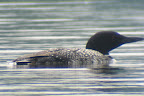
I experimented with taking photos through my spotting scope this July during a visit to Eric Z's lake place in northeast Wisconsin. I got some good results courtesy of a cooperative loon. See the album at Loon Awesomeness.


Monday, November 26, 2007

Manatee salad


In June 2007, I was fortunate to see some manatees in the manatorium* at the Lowry Park Zoo in Tampa, Florida. This manatee was going to town on a head of lettuce- some kind of manatee salad.

* I totally made up the word "manatorium.". A better word might be "Sirenium", from the Latin name of the manatee family, but it's just not as mellifluous.

Listen for the manatee music in the video (best from 0:20 to 0:55 or so).


Tonight at 11: When Manatees Attack British Naturalists.

Look out, Sir David!.